Is SEO dead in the AI era? Google says no
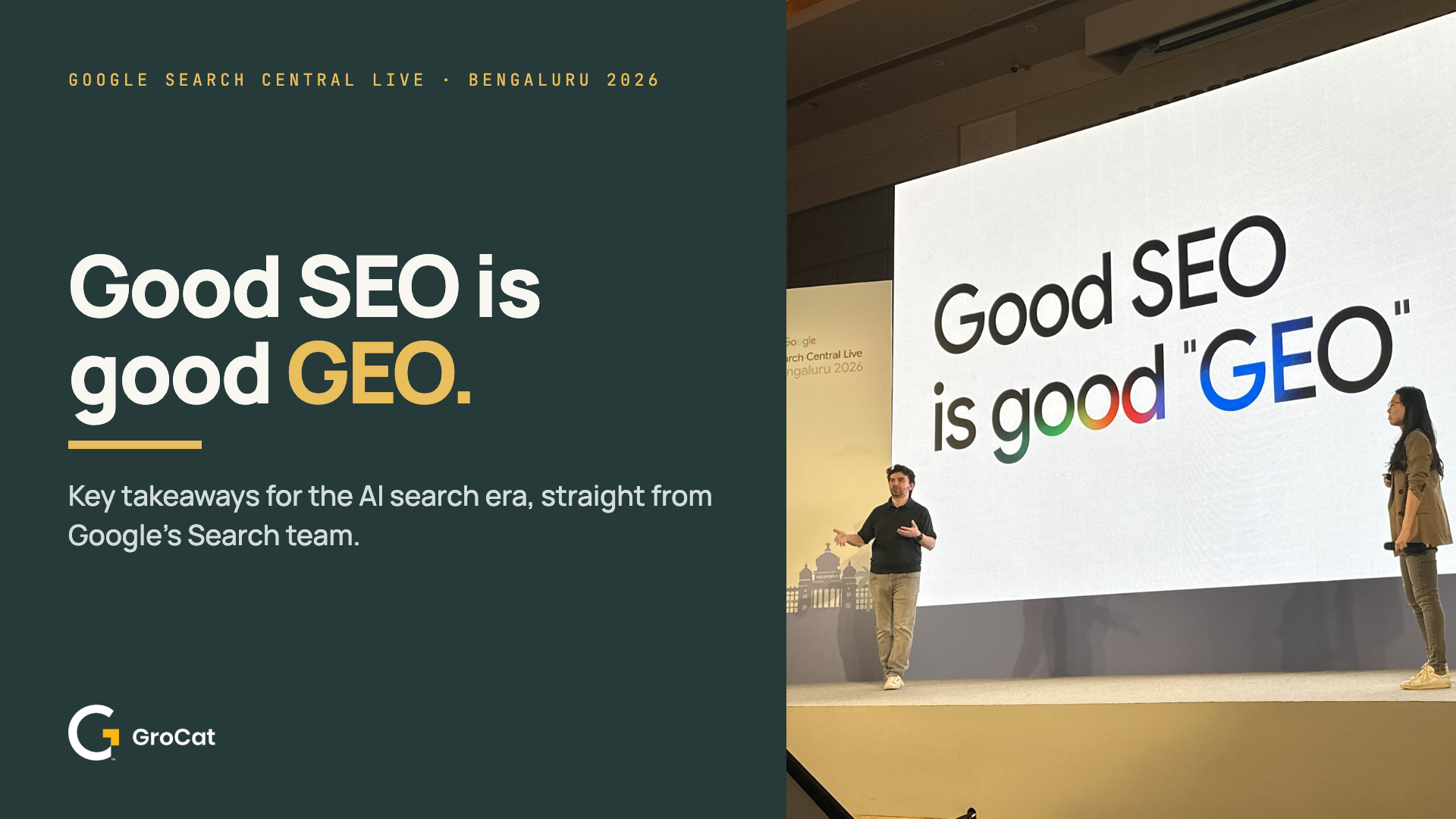
Good SEO is good GEO. That was the clearest message from Google Search Central Live Bengaluru 2026, held on 30 October 2026, and the GroCat team was in the room to hear it.
AI Overviews, AI Mode and assistants like Gemini have every business asking the same question: do we now need a separate strategy for “generative engine optimization” (GEO) or “answer engine optimization” (AEO)? Google’s Search team answered it directly. Their generative AI features are built on the same core ranking and quality systems as traditional Search, so the fundamentals still decide who gets seen.
Below are our key takeaways from the day: what is changing in how people search, which myths to drop, what Google means by quality, and the technical checks that keep your site eligible for both classic results and AI answers.
Key takeaways at a glance
- Good SEO is good GEO and AEO. Google’s AI features run on its core Search ranking systems. There is no separate playbook for AI.
- Search is growing, not shrinking. Google handles over 5 trillion searches a year, and AI Overviews has more than 2.5 billion monthly users.
- Queries are longer and more complex. AI Mode queries are about 3x the length of a traditional search, and 1 in 6 is voice or image.
- Write for people, not bots. You don’t need LLMS.txt or content “chopped” for AI.
- Quality is effort, originality, skill and accuracy, backed by E-E-A-T. Trust matters most.
- Technical basics still decide eligibility. Crawling, indexing, canonicals and hreflang determine what can appear in AI answers.
- Search Console is adding AI-era tools, including branded vs non-branded filters and AI-grouped queries.
Search is growing, not dying: the numbers Google shared
The “SEO is dead” headlines don’t match what Google presented. AI is adding to Search, not replacing it.
- Searches on Google per year: 5 trillion+
- AI Overviews monthly users: 2.5 billion+
- AI Mode monthly users: 1 billion+, with queries doubling every quarter
- People who also use AI assistants (Gemini, ChatGPT, Claude): make 52% more Google searches per month than non-users
People who use AI assistants search Google more, not less. For businesses, that means more moments where a customer could find you, and more ways to be left out if your content isn’t clear and trustworthy.
Figures as presented by Google on stage at the event.
How search queries are changing in the AI era
People now ask Google full questions instead of typing a few keywords. Google highlighted three shifts:
- Longer, natural-language queries. The average AI Mode query is about 3x the length of a traditional search, and queries of five or more words are growing 1.5x faster than shorter ones.
- Multimodal search. 1 in 6 AI Mode searches uses voice or an image, through tools like Google Lens and Circle to Search.
- More complex questions. People ask follow-ups and plan whole tasks, such as trips, purchases and routines, in one conversation.
What is query fan-out?
Query fan-out is how Google’s AI features handle these complex questions. The system expands one question into many related searches, gathers relevant pages from the Search index, then builds an answer. A page that covers a topic thoroughly, with clear answers to the related questions, has more chances to be pulled in.
What to do: answer the full question your customer is asking, not just the head keyword. Name your images clearly, write useful alt text, and make sure product, location and service details are easy to find.
SEO vs GEO vs AEO: why Google says it’s the same job
Google’s advice was blunt: don’t worry about what to call it. Good SEO is good GEO and good AEO, for three reasons it shared on stage:
- AI features are built on core ranking systems. AI Overviews and AI Mode sit directly on top of the same ranking and quality systems as regular results.
- Query fan-out uses the Search index. AI expands a question into related searches and pulls pages from Google’s index to answer it.
- AI answers highlight indexed content. If your page isn’t crawled, indexed and trusted, it can’t appear in an AI answer.
Google also cleared up a common mix-up. Gemini does not index content the same way Google Search does. They share early crawling and processing pipelines, but the end products are very different. Optimising for Google Search is what gets you into Google’s AI features.
Want to be found in AI answers as well as classic results? See our SEO services and Generative Engine Optimization (GEO) services, or read what GEO really means for businesses.
4 AI search myths to drop this year
Google named four beliefs that are leading businesses in the wrong direction.
- Myth: Optimise for AI over readers. Instead, optimise for people. No need to obsess over AI phrasing or chop content into fragments. LLMS.txt isn’t necessary.
- Myth: Build content for every possible consumer need. Instead, prioritise unique perspectives and expertise. Go beyond common knowledge and share your own experience.
- Myth: Your website is no longer relevant. Instead, keep content accessible. Make it crawlable, well-structured, fast and easy to read for people and AI tools.
- Myth: The old metrics don’t work anymore. Instead, focus on real business goals. Measure what matters: enquiries, calls, sales and leads.
What “quality content” means to Google: 4 pillars and E-E-A-T
Google doesn’t judge content by whether a human or AI wrote it. It judges the quality of the page and the whole website, using four pillars from its Search Quality Rater Guidelines:
- Effort: how much real human work went into making the page satisfying.
- Originality: unique content that isn’t available elsewhere, ideally with you as the original source.
- Talent or skill: made with enough skill to give visitors a satisfying experience.
- Accuracy: factually correct and, for “Your Money or Your Life” topics such as health and finance, consistent with expert consensus.
On top of these sits E-E-A-T: Experience, Expertise, Authoritativeness and Trustworthiness. Google was clear that untrustworthy pages fail regardless of every other factor.
Google also shared a simple rule: ML ranking systems are trained on content made by humans, for humans. Content written for people is still what works best for Google’s AI systems.
Read more: Google’s Search Quality Rater Guidelines, our guide to E-E-A-T signals that influence AI-generated search answers, and why AI-generated content alone fails to rank consistently. Need people-first content? Explore our content writing services.
The technical side: how Google crawls, indexes and deduplicates your site
AI answers can only use pages Google has crawled, indexed and chosen as the main version. Google walked through each step:
- Crawl, index, serve. Pages move from a crawl queue to processing (HTML parsing, rendering, deduplication and signal extraction), then into the index, where hundreds of signals decide what is served.
- Signals that matter at indexing include country and language, freshness, SafeSearch and spamminess. Google said its systems find 40 billion spammy pages every day.
- “Discovered – currently not indexed” means Google found the URL but delayed crawling it to avoid overloading your server. “Crawled – currently not indexed” means it crawled the page but chose not to index it yet. There’s no need to resubmit it.
- Deduplication groups exact, near-duplicate and structurally similar pages, then picks one representative URL. Pages that only localise the boilerplate, like a city name in a services template, can be treated as duplicates.
Multilingual SEO matters more with AI
Google said AI search makes multilingual SEO more important than ever. Use a separate URL per language, connect them with hreflang (in the HTML head, HTTP header or sitemap), and set an x-default page. Avoid the common mistakes: missing return links, invalid codes like “UK” instead of “en-GB”, and a region with no language.
Google’s 7-point technical checklist
- Use redirects for site migrations.
- Use correct HTTP status codes, and don’t block crawlers and agents.
- Check your rel=canonical links.
- Use hreflang to help Google localise.
- Report odd canonicals or hijacking in the Search Central community forums.
- Make secure pages that work.
- Keep canonical signals clear.
Not sure whether your key pages are indexed and canonical? Our SEO team can run a technical audit.
What’s new in Google Search Console
Google showed several Search Console features that make AI-era reporting easier:
- Branded vs non-branded filter: separate brand searches from new-customer discovery, using AI-assisted classification.
- Query groups in Insights: see similar queries clustered by intent, and spot groups that are trending down.
- Image and multimodal traffic: track visits from Google Lens, Circle to Search and image uploads.
- Weekly and monthly views: smooth out weekend dips in your charts.
- Custom annotations: pin notes such as “site migration” to dates (up to 120 characters).
- 24-hour and hourly view: watch the last 24 hours after a release (10 days hourly via the API).
- AI configuration (experimental): set filters and comparisons by typing a request in plain language.
Google also showed two visibility features. Readers can add your site as a Preferred Source, and Google said those readers are about 2x as likely to click through (here’s how to add the button to your site). Publishers and creators can now claim a Search Profile to shape how they appear on Search.
What this means for Indian businesses
For brands in India, the message from Google Search Central Live Bengaluru 2026 is reassuring: you don’t need to rebuild your strategy for AI. You need to do the fundamentals better.
- Write for real customers. Answer the full questions they ask, in the language they search in.
- Show your expertise. Share first-hand experience, real projects and named experts, which AI-generated filler can’t copy.
- Fix the technical basics. Make sure your key pages are crawled, indexed and canonical, and that multilingual sites use hreflang correctly.
- Measure what matters. Track enquiries, calls and branded searches, not rankings alone.
Talk to GroCat
At GroCat, we help businesses get found and get chosen across Google Search, Maps and AI-driven results. Want to know how your brand shows up today? Request a search visibility audit.