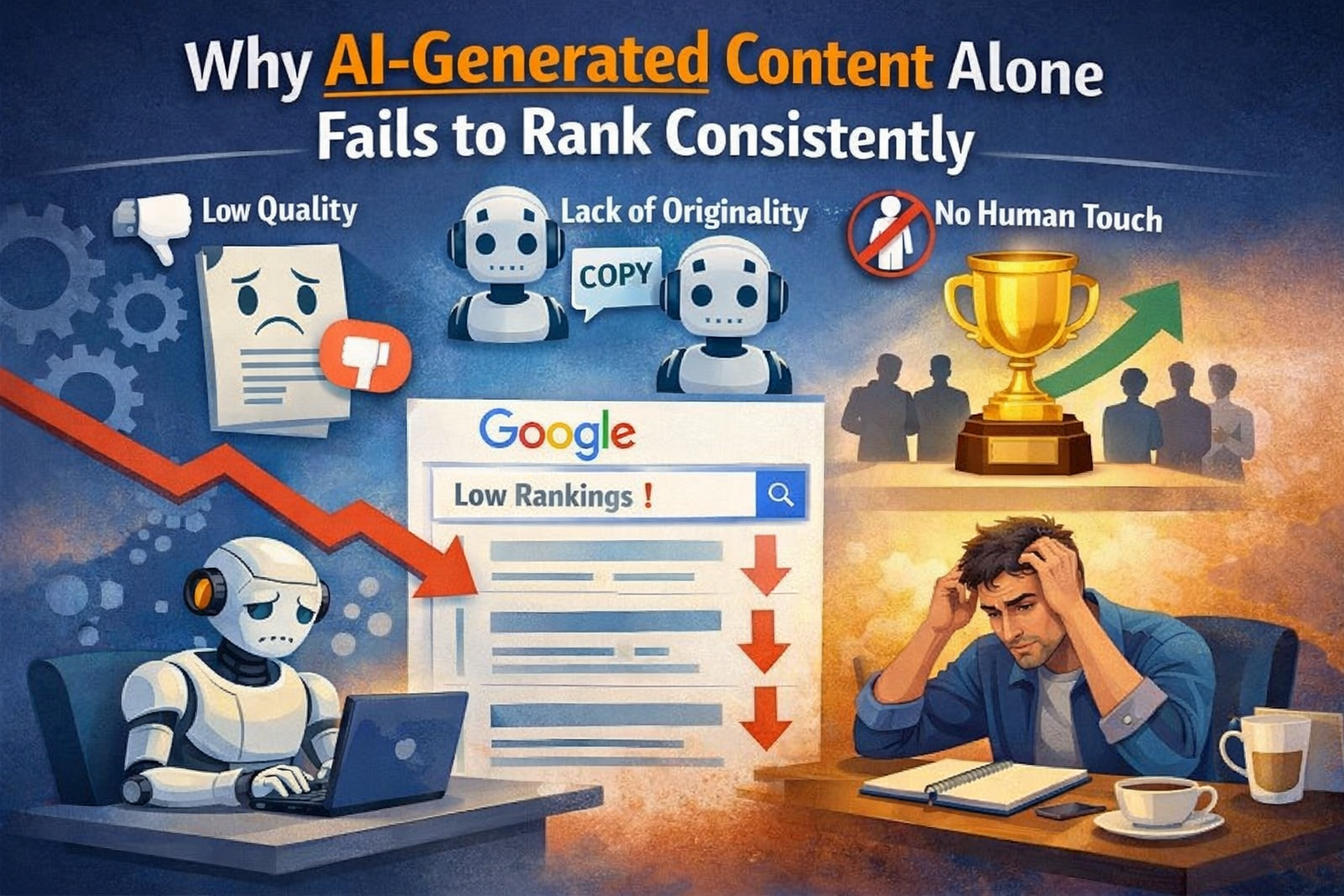
You published a batch of AI-written articles. You optimized the titles, checked the word counts, and hit publish with confidence. Then you watched the rankings — and what you saw was confusing. A couple of pages climbed. Most flatlined. A few ranked for a week or two and then quietly disappeared.
That's not a fluke. It's a pattern thousands of SEO teams are experiencing right now, and it points to a deeper problem than just "AI content."
This article explains why AI-generated content alone creates unstable rankings, what search engines are actually rewarding in 2026, and how to fix your content strategy before the gap between you and your competitors widens further.
The Real Problem Isn't AI — It's What's Missing
Let's get one thing straight: Google has never said "AI content will not rank." What it has said, repeatedly and clearly, is that low-effort, unoriginal content produced at scale will not rank consistently. That distinction matters enormously.
The issue isn't the tool. The issue is what the tool tends to produce when there's no human judgment involved: content that looks complete on the surface but lacks the depth, specificity, and trust signals that earn long-term visibility.
When you read a purely AI-generated article on almost any topic, you'll notice a familiar pattern — broad headings, safe generalizations, predictable advice, and a total absence of anything that could only come from real experience. Readers notice this. Search engines notice this. And over time, the rankings reflect it.
Why AI-Only Content Creates Unstable Rankings
1. It Adds Nothing New to the Conversation
Generative AI is trained to produce plausible, coherent text based on patterns from existing content. That means when you ask it to write about, say, email marketing best practices, it will produce something that sounds like a blend of the top 20 articles already ranking for that topic.
The result is content that's technically accurate but completely forgettable. Search engines don't need another version of what already exists. They need something that contributes — a real example, a tested process, a data point from your own experience, a perspective that can't be found anywhere else.
If your article could be swapped out for any of the other results on page one and no one would notice the difference, it isn't strong enough to hold a ranking over time.
2. Scaled Publishing Has Become a Red Flag
Publishing hundreds of articles quickly used to be a viable growth strategy. That window has closed.
Google now explicitly identifies "scaled content abuse" as a spam policy concern — the practice of generating large volumes of content primarily to manipulate rankings, especially when that content adds little or no value. This applies whether the content is written by AI, humans, or a combination of both. The distinguishing factor is effort and originality, not authorship.
Sites that pushed out 100, 200, or 500 AI articles in a short period are now some of the clearest examples of what not to do. Short-term traffic spikes followed by site-wide indexing slowdowns, ranking volatility, and weakened domain trust. The speed advantage became a liability.
3. Readers Can Feel the Lack of Real Experience
Even when AI content is factually reasonable, it often reads like it was written by someone who has read about a topic extensively but has never actually done it. And that feeling — that subtle absence of lived knowledge — erodes trust faster than most SEOs realize.
Think about fitness content that never mentions how hard a particular movement is to learn, or finance content that talks about investment strategies without ever acknowledging the emotional difficulty of holding through a downturn, or SaaS content that explains a feature set without showing a single real workflow.
These aren't just nice-to-haves. They're the difference between content that earns bookmarks, shares, and backlinks — and content that earns a quick exit.
4. Weak Intent Matching Kills Long-Term Performance
AI is reasonably good at producing content that appears relevant to a query. It's much weaker at producing content that actually satisfies the intent behind that query.
A page might rank briefly because it contains the right keywords and a reasonable structure. But if it doesn't fully answer what the user was trying to accomplish — if it's too generic for a commercial query, too shallow for an informational one, or too vague for a transactional one — engagement signals will deteriorate. Time on page drops. Bounce rate rises. Click-through rate weakens. And the ranking follows.
This is the most common explanation for the "ranked for two weeks and then dropped" pattern. The page was relevant enough to get surfaced. It wasn't useful enough to stay there.
5. Internal Duplication Quietly Damages Your Site
When teams produce large volumes of AI content without a clear topical strategy, something predictable happens: multiple pages start targeting the same keyword clusters with nearly identical content.
The headings are different. The words are shuffled. But the substance is the same. This creates keyword cannibalization — where your own pages compete against each other — and it creates what might be called "thin uniqueness," where no individual page is obviously bad, but the site as a whole starts to look repetitive and low-effort.
Search engines are good at detecting this pattern, and it weakens the performance of your entire site, not just the duplicate pages.
6. AI-Only Content Rarely Earns Links
Backlinks remain one of the strongest ranking signals, and they're also one of the clearest indicators of whether your content offers something genuinely worth referencing.
The honest truth is that AI-generated articles almost never earn organic backlinks. They don't contain original research. They don't offer unique data or tools. They don't have strong, well-supported opinions or frameworks that other writers want to cite. They're competent, but competent doesn't earn links. Useful, original, and credible does.
Without links, ranking for competitive terms is a constant uphill battle, and whatever positions you do hold are far more vulnerable to being displaced.
What Search Engines Are Actually Rewarding Right Now
Strip everything back and the picture becomes clear. Search engines — and increasingly, AI answer systems — want content that is:
Helpful: it actually solves the problem, not just gestures toward it
Reliable: accurate, current, and transparent about who's behind it
Distinct: it adds something that isn't already in the top results
Trustworthy: it shows evidence of real knowledge and accountability
None of those qualities are impossible to achieve with AI assistance. All of them are very difficult to achieve with AI alone.
The Right Approach: Human-Led, AI-Assisted
The goal in 2026 isn't to avoid AI. It's to use it where it helps and apply human judgment where it matters.
Start with a specific angle, not a generic keyword. Before you write anything, decide what unique perspective or contribution this piece will make. What do you know about this topic from direct experience? What does your audience actually struggle with that the existing results don't address?
Use AI for the structural and mechanical parts. Let it help with outlines, draft introductions, heading variations, and summaries of publicly available information. These are tasks where speed is an advantage and originality isn't critical.
Add the human layer that rankings depend on. This is where the real work happens — and where most AI-only strategies fall short:
- Real screenshots and step-by-step walkthroughs from actual use
- Honest accounts of what went wrong during a process, not just what to do
- Original examples drawn from your clients, your team, or your own experiments
- Expert review — even a 20-minute fact-check from someone who knows the topic adds credibility that AI cannot fake
- References to current policies, updated tools, or recent developments that reflect genuine awareness of the space
Edit for intent, not just polish. Before publishing, ask: does this fully answer the query? Is the solution visible in the first quarter of the page? Have we addressed the follow-up questions a reader would naturally have? Is there something here that would make a professional in this field nod in recognition rather than skim past it?
Make the page cite-worthy. For AI answer systems and for human linkers, credibility signals matter: a visible author with a bio, a "last updated" date, references to primary sources where relevant, and claims that are clearly supported rather than vaguely asserted.
A Quick Pre-Publish Checklist
Before any article goes live, run through these:
- Does this have a unique angle not already covered by the top five results?
- Is the intent match precise — informational, commercial, or transactional?
- Is there at least one original contribution — an example, a data point, a framework, or an expert insight?
- Have we demonstrated real experience somewhere in the piece?
- Are all claims accurate and verifiable?
- Is there a clear next step or action at the end?
- Have we checked for overlap with existing pages on the same topic?
If you can answer yes to all of these, the article is ready. If you can't, it isn't.
The Bottom Line
AI content isn't the problem. AI content without human judgment, original contribution, and genuine usefulness is the problem — and search engines have become very good at identifying the difference.
If your rankings have been unstable, the solution isn't more content. It's better content: fewer pages, stronger angles, real expertise, and a production process that treats AI as a capable assistant rather than a replacement for thinking.
Start with your ten best-performing pages. Add something real to each of them — a case study, an expert perspective, a workflow that only someone with actual experience could write. Watch what happens. Then rebuild your content pipeline around that standard.
That's what ranks consistently. Not volume. Not speed. Not the number of articles published this month. Trust — built one page at a time.